
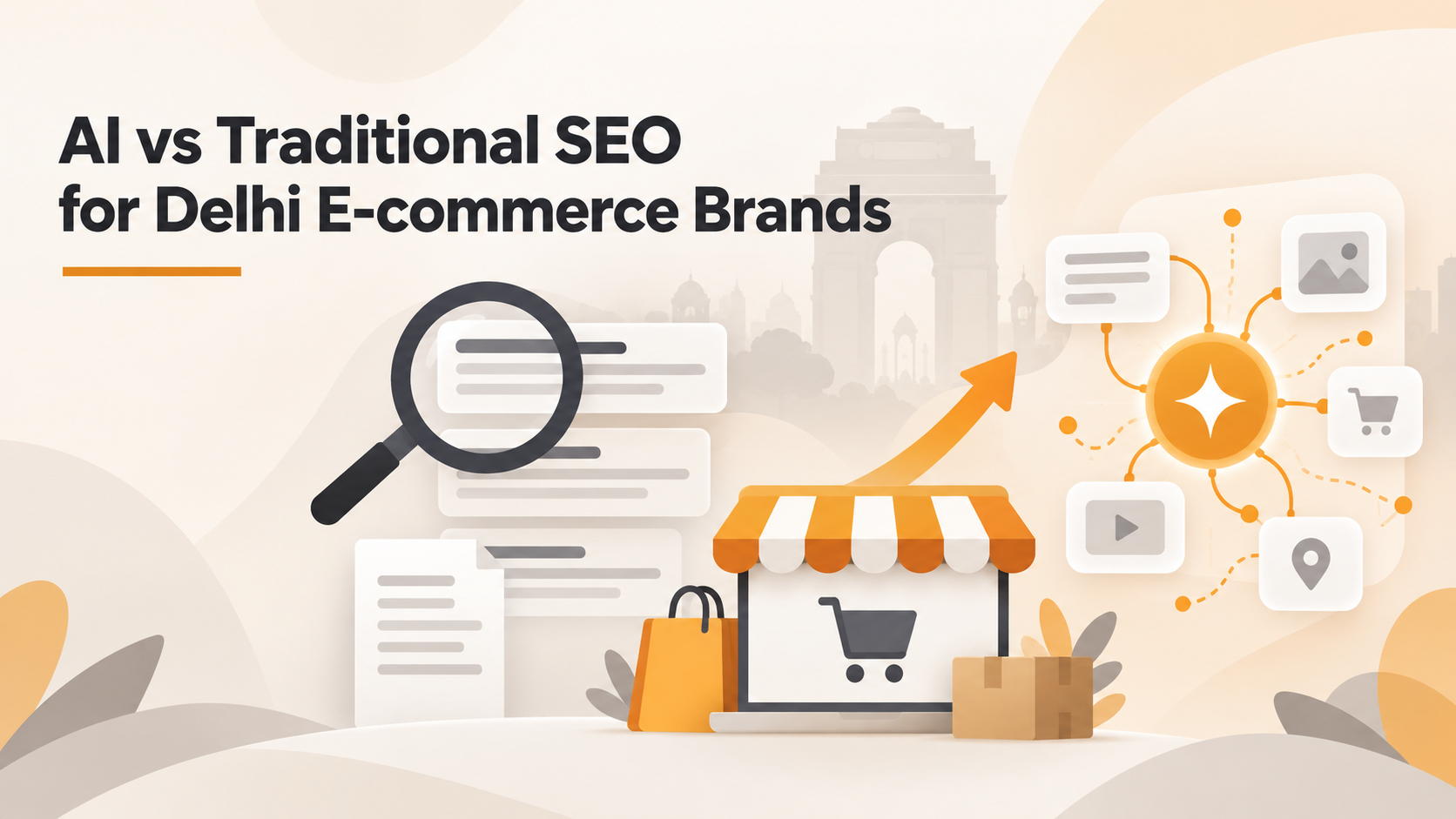
AI vs traditional SEO for e-commerce comes down to this: traditional SEO gets your product pages ranked in Google’s blue links, while AI-powered SEO adds structured data and answer engine optimisation (AEO) on top, so AI shopping assistants like ChatGPT, Gemini and Google’s AI Overviews can find and recommend your products directly. For Delhi e-commerce brands competing in an increasingly crowded market, understanding this difference determines where marketing budget actually moves the needle in 2026.
What Traditional SEO Still Gets Right
Traditional SEO fundamentals haven’t disappeared — they’re the foundation everything else builds on. Keyword research, backlink quality, page speed, mobile usability and on-page optimisation still directly affect whether Google ranks a product or category page at all. No amount of AI-era tactics compensates for a slow, poorly structured site that Google simply can’t crawl properly. Any Delhi e-commerce brand skipping these basics to chase AI visibility is building on a weak foundation.
Where AI-Powered SEO Adds a Genuinely New Layer
- Structured product data — schema markup that lets AI tools read price, stock and reviews with confidence, not just search engines
- Answer-ready content — buying guides and comparisons written so an AI tool can quote them directly when a shopper asks for a recommendation
- AI-assisted production at scale — catalogue-wide content and technical fixes produced faster, with human editing for accuracy
- Citation tracking — measuring not just search rankings but how often a brand is actually named inside AI-generated shopping answers
Side-by-Side: What Actually Changes
| Traditional SEO Approach | AI-Powered SEO Approach |
|---|---|
| Keyword-focused content for search rankings | Question-led content built to be quoted by AI tools, plus rankings |
| Backlinks as the primary trust signal | Backlinks plus consistent entity data and structured markup |
| Success measured by traffic and position | Traffic, position, and share of AI-generated answer citations |
| Manual content production | AI-assisted drafting at catalogue scale, human-edited |
Why Delhi’s E-commerce Market Specifically Feels This Shift
Delhi’s e-commerce and D2C scene is dense and competitive — multiple brands frequently target the exact same product categories and keywords. In a market that crowded, ranking position alone is a shrinking advantage, since competitors can often match a well-optimised page within weeks. Being the brand an AI tool actually names when a shopper asks for a recommendation is a harder position to copy, because it depends on structured data and content depth that takes longer to replicate than a simple keyword-matched page.
A Practical Way to Prioritise Between the Two
Neither approach replaces the other, but budget is finite, so sequencing matters. For most Delhi e-commerce brands, the practical order is: fix any real technical SEO gaps first (site speed, crawlability, basic on-page optimisation), then layer in product schema and AEO-focused content once the foundation is solid. Trying to win AI citations on top of a technically broken site rarely works — AI tools are, if anything, more sensitive to structured, trustworthy data than traditional search rankings are.
Common Misconceptions Worth Clearing Up
- “AI SEO replaces traditional SEO.” It doesn’t — it’s an additional layer, not a substitute. Sites still need to rank normally too.
- “More AI-generated content is automatically better.” Volume without editing produces generic content that neither ranks well nor gets cited — the AI-drafts-humans-edit model exists specifically to avoid this.
- “Schema markup is a one-time task.” Product catalogues change constantly; schema needs the same ongoing maintenance as pricing and inventory.
For more on how this applies specifically to online stores, see our AI marketing for e-commerce brands page, or our detailed guide on how AI marketing increases organic sales.
How to Audit Where Your Store Currently Stands
Before committing budget to either approach, a straightforward self-audit helps: check your top 5-10 product pages in Google’s Rich Results Test for schema coverage, review your Core Web Vitals scores for mobile (a large share of Delhi’s e-commerce traffic is mobile-first), and ask an AI assistant a genuine category question to see who gets recommended. These three checks alone usually reveal whether the priority is fixing technical SEO fundamentals or building out AEO-focused content.
What This Looks Like in Practice, Month by Month
A realistic sequence for a mid-sized Delhi e-commerce brand: month one focuses on technical fixes and schema markup across the highest-traffic product pages, since these compound fastest. Month two extends schema coverage across the full catalogue and begins producing AEO-structured category and buying-guide content. By month three, citation tracking becomes meaningful, since AI tools need time to crawl and trust the new structured data before referencing it consistently. Trying to skip straight to content production without the technical foundation typically produces slower, less durable results.
Budget Allocation: A Rough Starting Point
For brands unsure how to split spend between the two approaches, a reasonable starting allocation is roughly 60% toward technical SEO and content fundamentals (the things that still drive traditional rankings) and 40% toward AEO-specific work (schema, structured buying guides, citation tracking) — shifting more toward AEO over time as the technical foundation solidifies and the category becomes more AI-search-driven. This isn’t a fixed rule, but it avoids the common mistake of over-investing in AEO before the basics are handled.
Frequently Asked Questions
Should I stop investing in traditional SEO and focus only on AI optimisation?
No. Traditional SEO fundamentals (site speed, crawlability, keyword targeting, backlinks) remain the foundation. AI-powered SEO and AEO add a layer on top — they don’t replace the basics.
How do I know if my e-commerce site needs AI-focused SEO work?
A quick test: ask an AI tool a genuine buying question in your product category and see if your brand or a competitor gets named. If it’s consistently a competitor, that’s a concrete AEO gap worth addressing.
Is this only relevant for large e-commerce catalogues?
No — smaller catalogues often see AI-assisted content and schema work pay off faster, since there’s less backlog of pages to fix before the whole catalogue is properly optimised.
What’s the single highest-priority fix for most Delhi e-commerce sites?
Product and Offer schema markup, in most cases. It’s a technical fix rather than new content, and it directly affects whether both Google and AI tools can read pricing, stock and reviews accurately.
Want to know exactly where your store stands? Book a free AI marketing audit with SocialNinjaz.


AI vs Traditional SEO: What Delhi E-commerce Brands Need to Know
AEO for Real Estate: Getting Your Listings Cited by AI Search Tools

How AI Marketing For E-commerce Brands Increase Organic Sales

What Is an AI Marketing Agency? A Complete Guide for Delhi Businesses (2026)